Understanding Your Wellness Scores
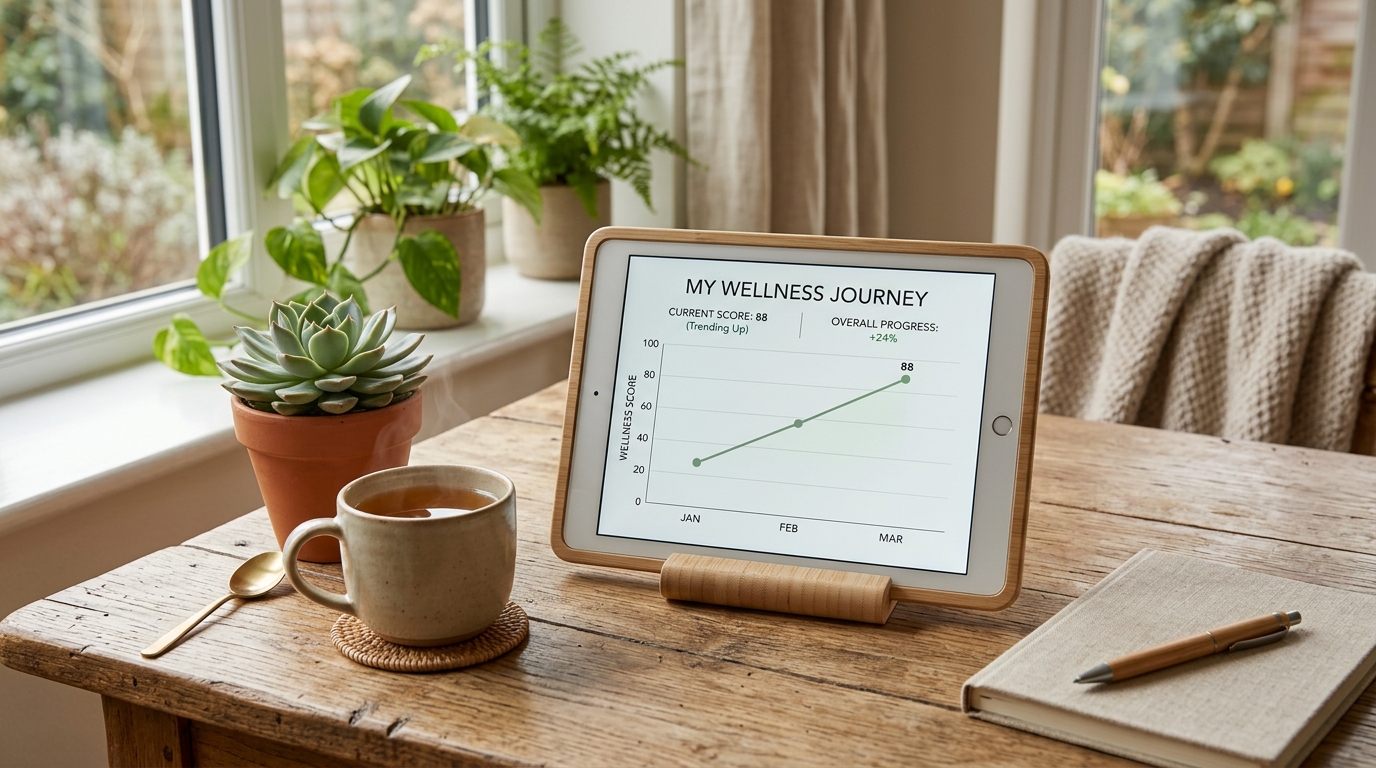
At 2 weeks, 1 month, and 3 months after your psilocybin journey, we'll ask you to complete brief wellness check-ins. These use two validated clinical scales — the PHQ-9 and GAD-7 — to track how you're doing over time. Here's what these numbers mean, why they matter, and how to use them.
What is the PHQ-9?
The Patient Health Questionnaire-9 (PHQ-9) is a 9-question scale that measures symptoms of depression over the past two weeks. Each question is scored from 0 (not at all) to 3 (nearly every day), giving a total score between 0 and 27.
PHQ-9 severity levels
| Score | Severity | What it means |
|---|---|---|
| 0–4 | Minimal | Symptoms are within the normal range. No clinical concern |
| 5–9 | Mild | Some depressive symptoms present. Monitor and continue integration practices |
| 10–14 | Moderate | Clinically significant symptoms. Your facilitator may recommend additional support |
| 15–19 | Moderately severe | Active treatment may be recommended alongside integration |
| 20–27 | Severe | Significant symptoms. Your care team will follow up with you directly |
What is the GAD-7?
The Generalized Anxiety Disorder-7 (GAD-7) is a 7-question scale that measures anxiety symptoms over the past two weeks. Scored the same way — 0 to 3 per question, total between 0 and 21.
GAD-7 severity levels
| Score | Severity | What it means |
|---|---|---|
| 0–4 | Minimal | Anxiety symptoms within normal range |
| 5–9 | Mild | Some anxiety present. Mindfulness practices may help |
| 10–14 | Moderate | Clinically significant. May benefit from additional support |
| 15–21 | Severe | Significant anxiety symptoms. Your care team will follow up |
What the research shows
Clinical trials of psilocybin-assisted therapy consistently show significant reductions in both PHQ-9 and GAD-7 scores. In the Johns Hopkins studies of treatment-resistant depression, the average PHQ-9 score dropped from the "moderately severe" range to the "mild" range within two weeks — and maintained that improvement at 12 months.
At Meadow, we see similar patterns. Most clients show meaningful score reductions at the 2-week check-in, with continued improvement at 1 and 3 months.
How to interpret your trend
In your portal's Integration Hub, you'll see sparkline charts showing your PHQ-9 and GAD-7 scores over time. Here's how to read them:
- Downward trend: Scores are decreasing — this is the expected pattern. Your symptoms are improving
- Flat line: Scores are stable. If they're already low, this is fine. If they're elevated, it may be worth discussing with your facilitator
- Upward spike: A single elevated score doesn't indicate a problem. Life events, stress, poor sleep — many factors affect individual check-ins. Look at the overall trend, not individual data points
- Sustained increase: If scores trend upward over multiple check-ins, your facilitator will reach out to discuss additional support options
These numbers don't define you
Wellness scores are clinical tools, not character assessments. A high score doesn't mean you've failed, and a low score doesn't mean you're "fixed." They're data points — useful for tracking patterns and identifying when extra support might help.
Some important nuances:
- Scores can temporarily increase after a session as difficult material surfaces for processing. This isn't a setback — it's part of the integration process
- The PHQ-9 and GAD-7 measure symptoms, not wellbeing. You may be doing important inner work that doesn't show up in these particular scales
- Context matters. A score of 12 during a genuinely difficult life period means something different than a score of 12 during a stable period
When we follow up
Your facilitator reviews your wellness scores as part of your ongoing care. They will reach out if:
- Scores indicate moderate or higher severity on either scale
- There's a significant increase from your previous check-in
- You flag any concerns in the check-in comments
You don't need to wait for a scheduled check-in to reach out. If you're struggling, contact your facilitator through the messaging feature in your portal. That's what it's there for.
Check-in due?
Wellness check-ins take about 2–3 minutes. Complete yours in the client portal.
Go to Your Portal